

How to Fuel and Hydrate Your Long Runs
Confused about how to hydrate and fuel your long runs? You’re not alone. Picture this: You’re 2 hours into a long run when, out of nowhere, your legs get heavy, your brain goes foggy, and the wheels come off. Maybe you’re crying on a street corner. Or maybe you’re starting to think, “I can’t do this. I’ll never be ready”. Or the opposite, you drank so much water your stomach is sloshing or you're desperately looking for a bathroom. Both are fueling problems, and both are preventable.
Here's the thing nobody talks about at most running stores: fueling for a long run isn't about willpower or what your friend or favorite influencer does. It's a math problem. Your body burns fuel at a predictable rate depending on how hard you're running, how long you're running, and what conditions you're in. Get the math right, and long runs feel manageable. Get it wrong, and you're either bonking or bloated.
The Numbers, By Run Length
Here's what we teach and practice in the Badass Lady Gang app — the actual math that translates to what you need on race day.
Under 60 minutes (easy recovery run or short steady run) — Your body can tap glycogen stores and fat without additional fuel. You don't need to eat (unless of course you haven’t eaten in a few hours. THEN, a pre-run snack or fuel will help).
Hydration: about 8 oz of water 15-20 minutes before the run (not right before — that's just sloshing), then 8-16 oz over the course of the run depending on temperature and sweat rate.
Post-run: something with carbs + protein within 30-45 minutes to start recovery.
This is a good low-stakes run to test a new pre-run snack — if it sits weird in your stomach at easy pace, you know not to use it before a harder effort.
90-minute long run, moderate effort — Now your glycogen is starting to deplete, and fueling strategy matters.
Hydration: water plus electrolytes (sodium helps with absorption and retains fluid in your bloodstream). Aim for 4-6 oz every 15-20 minutes.
Fuel: a carb source starting around the 30-35 minute mark, then again around 70-75 minutes — gels, energy chews, real food if your stomach cooperates.
Carbs per hour: roughly 30-45 grams, depending on your body size and effort.
2-hour run, hot day or hilly terrain — Everything above gets dialed up, because you're losing more fluid and burning fuel faster.
Hydration: 4-8 oz every 15-20 minutes, leaning harder on electrolytes than plain water — plain water alone can dilute your blood sodium when you're sweating heavily.
Fuel: every 30 minutes. Glycogen stores won't last 2+ hours of sustained effort; you need external carbs to keep the engine running.
Carbs per hour: 45-60+ (possibly upwards of 90) grams, depending on sweat rate and intensity.
Why Carbs Matter (The Boring But Important Part)
Carbohydrates break down into glucose, which is what your muscles are actually burning during hard effort. Your liver and muscles store some as glycogen — roughly 90 minutes worth at a steady effort. After that, you're running on fumes unless you eat.
This isn't a diet rule. It's biochemistry. Running a long distance on a guess about whether you need fuel isn't willpower — it's inefficient. The athletes who fuel least are usually the ones most likely to hit a wall; it's not toughness, it's running the metabolic equivalent of on empty. Your brain needs glucose too — when glycogen drops, decision-making gets fuzzy and pacing choices get worse.
Why Your Number Is Different From Your Friend's
Two women, same pace, same heat, same distance, can sweat at wildly different rates — one might lose close to 2 liters an hour, another closer to 1. A generic "drink 16 oz an hour" rule throws both of them off: one gets overhydrated and bloated, the other gets dehydrated.
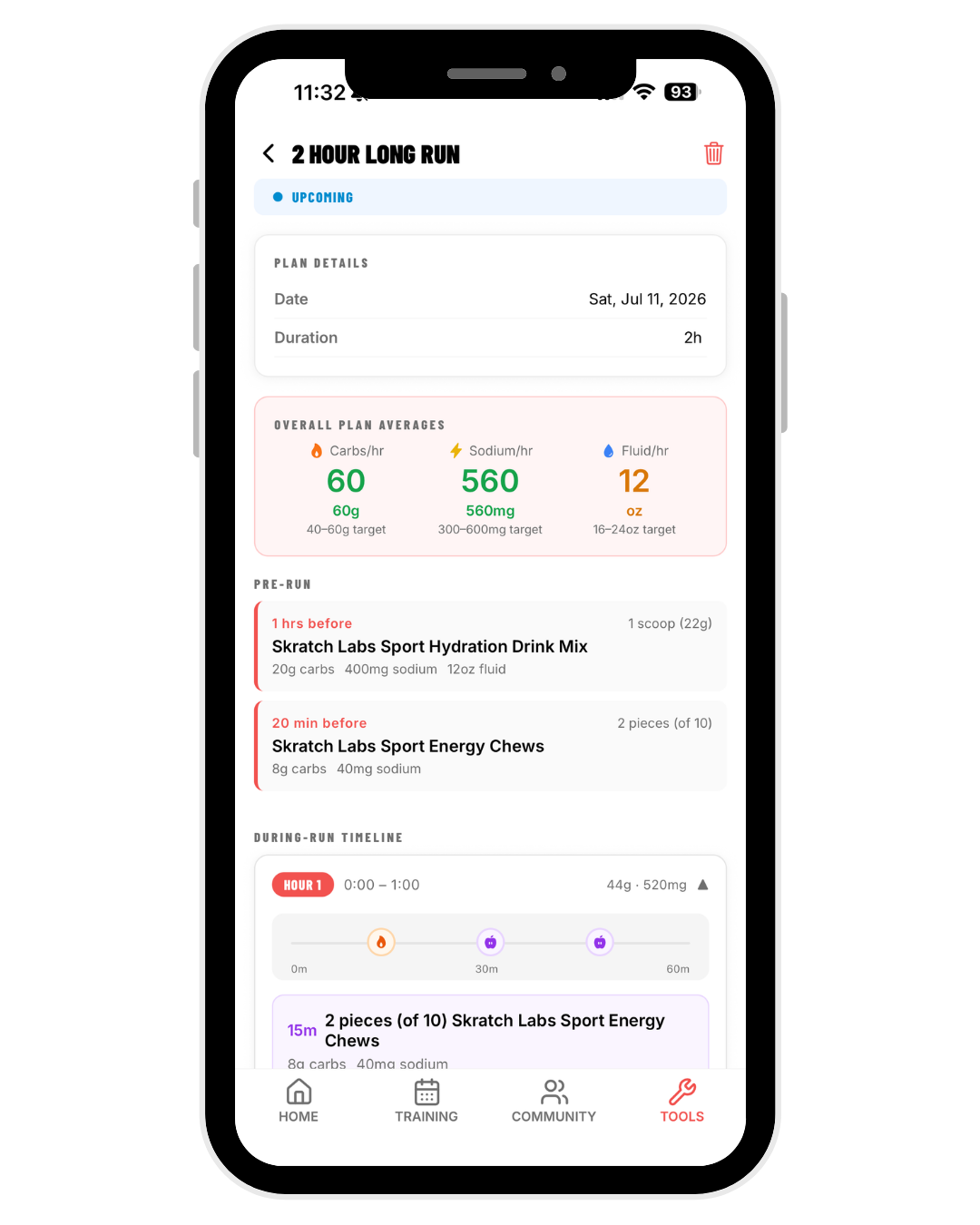
That's exactly what BALG's Fueling & Hydration Planner in our Badass Lady Gang app is built to fix.
What This Does NOT Tell You
The Planner gives you a strong starting estimate — it doesn't replace testing in training. It can't account for a day you're sick, unusually stressed, or racing somewhere with a totally different climate than you trained in. Treat its numbers as your baseline, then adjust based on what you actually log.
How It Works
Before your long run, you log exactly what you plan to take and drink to fuel and drink during your long. From right before you start to hour by hour, you’ll log it in the tracker. This way, you can get an idea of how many oz of fluid you plan to take in and how many grams of carbs. Then, with that visual, you can tweak if you’re low and avoid bonking before you start.
After the run, you log how much you actually drank, what you ate, how it felt (energy, GI, stomach comfort). You’ll delete what you didn’t use and add in anything that wasn’t planned for.
Over time, the app builds a personal database of your real data. You’ll get an idea of what works for you in hot weather, cold weather, really long runs, hard runs, and shorter runs.
That data is gold when you're planning race day. Instead of guessing, you walk in with a plan built on months of your own evidence — and you're not trying anything new because you've already practiced it.
The Fueling & Hydration Planner is free for everyone to use on the Badass Lady Gang training app available on web, ios or android.
Because at Badass Lady Gang, we believe that running smarter shouldn’t break the bank. So we’re here with the tools and resources to help you kick ass and take names. Enjoy!



— Coach Kelly
