

EXTREMELY Beginner Tips on How to Start Running (From the Former President of the "I F*cking Hate Running Club")
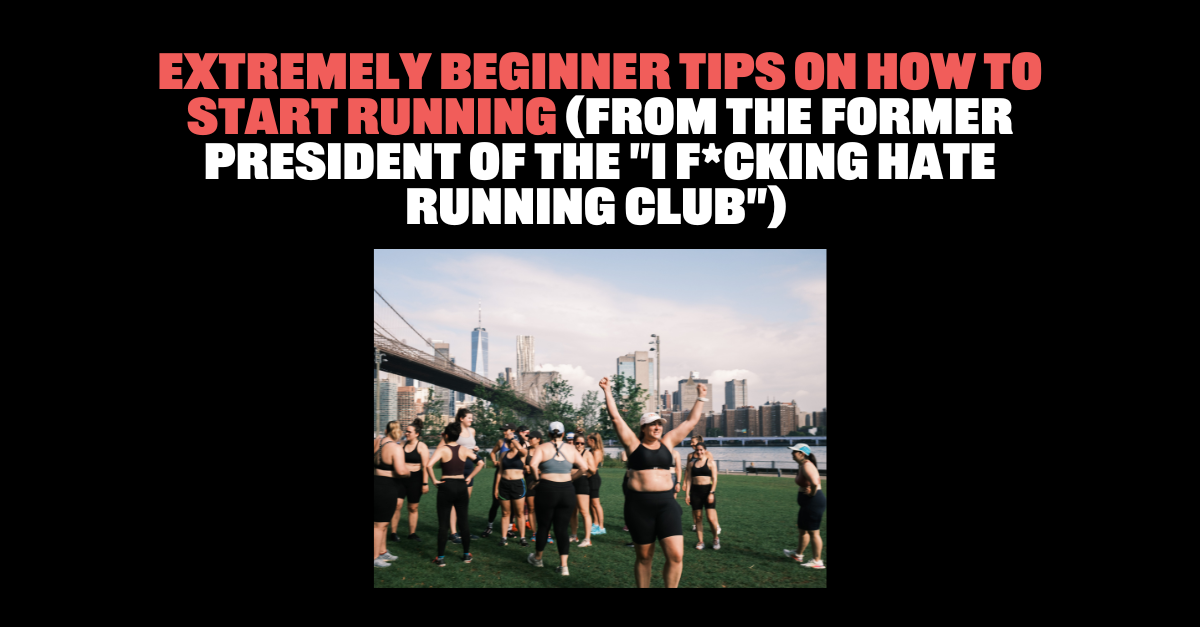
Listen. I get it. You don't like running. You might really hate running. The thought of lacing up sneakers and voluntarily subjecting yourself to running torture makes you want to scream. HELL, maybe you never even think about it at all because you never in a million years thought you'd enjoy something like running.
I used to be you.
Hi, I'm your friendly neighborhood former running-hater (and self-proclaimed former president of the I f*cking hate running club), and I'm here to tell you that if my fabulous I HATE ALL FORMS OF EXERCISING ASS can become someone who actually runs (willingly and gleefully!), you can too. (If that's what you want. You don't have to run if you don't want to.)
PSA: This shit takes time. You're not gonna fall in love with it immediately. I'm not going to promise you runner's high in week one. But I am going to give you the extremely beginner tips that actually worked for someone who once got SARBED (School Attendance Review Board) because I ditched so much PE they threatened not to let me graduate high school. 🙃
Why You Should Trust Someone Who Hated Running
Most running guides are written by people who were born with gazelle DNA and have been running since they could walk. That's not me. I didn't play sports growing up. I'm the person who used to purposely roll her ankle to get out of running the timed mile.
And then once I did start running, it was pretty horrifying. I cried on street corners. I self-objectified myself as cars drove by. I thought they judged me. I felt so insecure. And this was back in 2012 when we didn't really have social media to normalize struggle running. I had to be the change I wanted to see by starting a blog and talking about pooping your pants mid-run. (Be the change you wish to see in the world…right?)
But here's the thing: not being a naturally gifted runner makes me more qualified to help you, because it IS ACTUALLY HARDER FOR YOU. I'm now a certified running coach and I know every mental block, and every "this is stupid" thought that's going through your head right now and I want to help. Because running is a really, really great way to challenge what you're capable of, make friends, and work on yourself.
Want a foolproof plan to get started? I built a FREE Become a Runner 8-Week 5K plan right into the Badass Lady Gang app that takes you from "I can't run" to 5K finisher with audio-guided runs, strength training, and a community of thousands of women who started exactly where you are. Grab it on the web app, iPhone, or Android — no credit card, no catch. But more on that later. First, let's cover the basics.
The #1 Rule: Stop Trying to "Run" Right Away
This is where everyone screws up. You watch a movie montage, get inspired, tie your shoes too tight, sprint out the door like you're being chased by bees, and return two minutes later ready to die. Congratulations, you probably just convinced yourself you hate running or that it just isn't for you.
Here's what actually works in the beginning: walking breaks.
What are walking breaks (And Why is it Your New Best Friend?)
RUNNERS WALK. But giving yourself structured intervals of running and walking is exactly what it sounds like. You run a little, walk a little, repeat. It's the training strategy that doesn't make you feel like your lungs are trying to escape through your ribcage.
Start ridiculously easy:
Run for 30 seconds
Walk for 1-2 minutes
Repeat 8-10 times
That's it. That's the workout.
Not 30 seconds running at Olympic-trial pace. Just a slow jog. Conversational pace is the goal. Eventually, you'll be able to hold a conversation when you run but don't panic if you're huffing and puffing WHILE you run slow in the beginning. You're building aerobic fitness so trust the process. It doesn't necessarily ever get easier but eventually, you'll get stronger and find ease in the suck.
After a couple weeks of this, when it starts feeling weirdly… manageable? My free Become a Runner 8-Week 5K plan literally walks you and talks you through every run — just open the BALG app and press play. The key is gradual progression, not trying to become Usain Bolt by Tuesday.
Choosing Running Shoes: It's Simpler Than You Think
The running shoe industry wants you to believe you need a PhD to pick shoes. You don't.
Here's the actual secret: Get shoes that feel comfortable. That's it.
Forget the "wet foot test" or fancy gait analysis unless you're already having pain. Research shows that comfort is the best predictor of the right shoe for you. Go to a running store (not a department store), tell them you're a beginner, try on multiple pairs, and pick the ones that feel best.
I ran my first half marathon (and the first 4 months of my running life) in Nikes that were too small (I didn't know you size up 1/2 size for running shoes back then!) that I got off the shelves at Nordstrom Rack. They were fine. What you have is fine for now.
Quick shoe tips:
Leave a thumb's width of space between your toes and the shoe's end
Your foot should feel secure but not squeezed
Don't buy shoes that are too small — your feet swell during runs
Running shoes are good for walking too, so you can break them in gently
Budget $80-$150 for decent quality
Replace them every 300-500 miles (or when they look sad and compressed)
IF YOU CAN, go to a local running store and get sized
The "Bare Minimum" Gear Checklist
Good news: You don't need much to start running. Don't let fancy gear become another excuse.
Must-haves:
Comfortable running shoes (see above)
Comfortable clothing that doesn't restrict movement
A good sports bra (if applicable) — high-impact activities demand proper support. Don't worry, the BALG app has a free Sports Bra Finder to help you find the best fit. It's great for everyone but especially great for runners with big boobs.
Nice-to-haves (but totally optional at first):
Moisture-wicking clothes
Running watch or fitness tracker
A running app that actually coaches you (that's what the BALG app is for)
Water bottle for hot days
Don't geek out on electronics until you know you're going to stick with this. Your phone with the free BALG app works perfectly fine.
How Often Should You Run? (Probably Less Than You Think)
Beginner running frequency: 2-3 times per week.
That's it. You're not training for a half marathon (yet). You're building a habit and letting your body adapt. Running is high-impact, and your joints, muscles, and connective tissues need time to strengthen.
Want a complete 8-week plan laid out for you? The free Become a Runner 5K plan in the BALG app tells you exactly when to run and when to walk with audio-guided workouts, plus weekly strength training and community support. Tens of thousands of runners have gone from the couch to their first 5K with this exact plan. Download it on web, iPhone, or Android.
Sample beginner week structure:
Monday: 20 minutes of run-walk intervals
Tuesday: Rest or walk
Wednesday: Rest or walk
Thursday: 20 minutes of run-walk intervals
Friday: Rest
Saturday: 25 minutes of run-walk intervals
Sunday: Rest or gentle walk
Running Form Basics (Without Overthinking It)
Don't obsess over form at first, but keep these basics in mind:
Body:
Stand upright, slight forward lean from ankles (not waist) [Imagine you're pushing a stroller up a hill]
Keep your gaze forward, not at your feet
Relax your shoulders — they shouldn't be up by your ears
Keep your hands relaxed like you're carrying a handful of quarters (coins you'll put in the proverbial coin jar after every run)
Arms:
Natural bend at 90 degrees
Swing naturally forward and back (not across your body)
Keep hands relaxed, not clenched
Feet:
Land mid-foot under your body, not with a giant stride in front
Focus on quick, light steps rather than long, pounding ones
Don't overthink it
Breathing:
Whatever feels natural works
If you're gasping, slow down or take a walk break
The 10-Minute Rule (For When You Really Don't Want To)
Here's a mental trick that saves runs: Commit to just 10 minutes and get out the door as fast as possible.
Tell yourself you only have to run for 10 minutes, then you can walk back home. Nine times out of ten, once you hit that 10-minute mark, you'll be warmed up and ready to get it over with. So, you'll keep going. But if you still feel terrible? Fine, stop. At least you got 10 minutes done. Something is always better than nothing.
This works because the hardest part of running is starting. Once you're out there moving, it often gets easier to just walk the time if running is too much.
Dealing With Soreness and "Does This Mean I'm Dying?"
Normal:
Muscle soreness 24-48 hours after running (especially at first)
Mild fatigue
Heavy breathing during runs
Not normal:
Sharp, stabbing pain
Pain that doesn't go away after a few days
Pain that gets worse during a run
Any pain that is above a 4/10 on the pain scale
Listen to your body. Mild discomfort as you adapt is expected. Actual pain is your body saying "STOP." If something hurts beyond normal muscle soreness, take extra rest days and consider seeing a physical therapist. (PS: Physical therapy isn't just for injured runners. The best way to treat an injury is by preventing it. PREHAB. But not all PTs are the same. Find one who sees runners. They're a great secret weapon if you have the resources available to you.)
Pro tip: Gentle movement on rest days (walking, stretching, yoga, cycling, swimming, etc.) can actually help reduce soreness better than complete immobility.
The Truth About Pace (Ignore It)
As a beginner, don't worry about pace. Seriously. Don't even look at it.
I used to google "what is a good running pace" ALL THE TIME when I started running. The best running pace is your running pace.
Your only goal right now is to get out there consistently. Speed may come with time and fitness. It also might not. If you focus on pace too early, you'll either burn out or get injured trying to hit some arbitrary number.
Run at a pace where you could hold a conversation. That's your target. Not sprinting. Not racing. Just moving.
The goal is to feel stronger. We're chasing a sense of ease on the run. That's the goal.
Fueling: Do You Need Special Running Food Like Gels or Gus?
Short answer: Not yet.
If you're running for less than an hour, you don't need special mid-run fuel. Your body has enough stored energy for that.
Pre-run eating tips:
Don't run on completely empty or fasted
Eat a small, carb-based snack 30-60 minutes before running
Good options: banana, handful of raisins, piece of toast, glass of juice, a handful of gummy bears, etc.
Avoid heavy, fatty, or very fibrous foods right before running
Stay hydrated, but don't chug a gallon of water right before (no chugging, ever)
For runs longer than an hour (which won't be you for a while), start researching running gels, chews, and hydration strategies. Other great options: CANDY. Nerds clusters, Haribo gummy bears, Swedish fish, fig newtons, and Uncrustables are all great options for affordable mid-run fuel.
Setting Goals Without Setting Yourself Up For Failure
Goals can be motivating, but unrealistic goals can be demoralizing.
Good beginner goals:
Run continuously for 20 minutes without stopping
Complete a 5K (3.1 miles)
Run 2-3 times per week for a month straight
Sign up for a 5K race 2-3 months away
Not-So-Great beginner goals:
Run a marathon in 3 months
Run a 6-minute mile
Run every single day
Look like or feel like a professional runner in 2 weeks
Pick one achievable short-term goal and one exciting (but realistic) long-term goal. Celebrate the small wins — they're what keep you going.
Common Beginner Mistakes (And How to Avoid Them)
Mistake #1: Doing too much, too soon
Solution: Follow the 10% rule — don't increase your weekly running time/distance by more than 10% each week.
Mistake #2: Running too fast
Solution: Slow down. If you can't talk in full sentences without gasping for breath every other word, you're going too fast. It should feel "natural" ish.
Mistake #3: Skipping rest days
Solution: Rest days are when your body gets stronger. They're not optional.
Mistake #4: Comparing yourself to other runners
Solution: Run your own race. Someone else's Week 1 might be your Week 10, and that's fine. SOME PEOPLE ARE NATURALLY GOOD AT THIS. Don't compare yourself to them. It's apples to oranges.
Mistake #5: Quitting after one bad run
Solution: Bad runs happen to everyone. One terrible run doesn't mean you're bad at running.
Mistake #6: Not warming up
Solution: Dynamic warm ups make the first 10 minutes suck less.
"But What About My Knees?"
Running does NOT destroy your knees.
Multiple research studies show that running doesn't increase your risk of osteoarthritis. In fact, it may even lower your risk. The human body is designed to run — you just need to build up gradually and let it adapt.
If you have existing knee issues, talk to a doctor or physical therapist about whether running is appropriate for you. But if you're worried that running will create knee problems in an otherwise healthy person? Don't be. It's a myth.
Staying Motivated When the Newness Wears Off
The first few runs are fueled by motivation and willpower. But motivation fades. Here's how to keep going when the honeymoon phase ends:
Build the habit:
Try to run at the same times on the same days
Lay out your running clothes the night before
Find an accountability buddy or join a community like Badass Lady Gang — the BALG app has a free community, plus chapters all over the US and Canada
Use the app to track your progress (seeing your stats improve is addicting) — grab it on iPhone or Android
Sign up for a race to give yourself a deadline
Mix up your routes to keep things interesting
Create a killer running playlist
Remember why you started:
Write down your "why" and read it on tough days
Notice the non-scale victories: better mood, more energy, sleeping better
WRITE DOWN wins every day with things you're feeling proud of. ACKNOWLEDGE YOUR PROGRESS
Ready for a Proven Plan? Get the FREE Become a Runner 5K Plan in the BALG App
Look, I get it. Reading tips is one thing. Actually doing it is another. That's why I built a completely FREE plan right into the Badass Lady Gang app that takes all the guesswork out of getting started.
Download the app and start free on BALGTraining.com, the App Store (iPhone), or Google Play (Android).
🎯 What You Get (Completely FREE):
Complete 8-Week Progressive Plan — 3 running days per week starting with walk/run intervals, gradually building endurance without overwhelming you. A proven system that's worked for tens of thousands of women.
Coach Kelly's Audio-Guided Runs — I literally tell you exactly when to run and when to walk. Entertaining coaching that makes time fly by (no boring instruction here), with real talk, encouragement, and laughs every step of the way.
Runner-Specific Strength Training Videos — weekly strength workouts designed to prevent injuries. Short, effective sessions that complement your running and build the strength you need without spending hours in the gym.
Weekly Community Support & Accountability — connect with thousands of badass women on the same journey. Share struggles, celebrate wins, stay motivated. Never feel alone or lost.
"Run, Selfie, Repeat" Podcast Integration — curated weekly episodes perfectly timed with your training phase, for extra motivation, tips, and real stories from women like you.
📅 Your 8-Week Journey:
Weeks 1-2: Start with gentle walk/run intervals — we meet you exactly where you are
Weeks 3-4: Build confidence as running time gradually increases
Weeks 5-6: Feel yourself getting stronger as running becomes easier
Weeks 7-8: Surprise yourself by completing your first 5K!
💪 Perfect For:
Complete beginners who've never run before
Former runners getting back into it after time off
Card-carrying members of the "I f*cking hate running club"
Anyone who thinks they'll only run if being chased
Women wanting confidence and community, not judgment
Why This Works When Others Don't:
This isn't just another cookie-cutter plan. I understand that running can suck AND be amazing. My approach combines:
Real Talk: No fake motivation — just honest, relatable coaching
Entertainment: Laugh your way through training instead of suffering
Community: Thousands of women supporting each other every single day
Proven Results: Tens of thousands have successfully completed this program
This challenge isn't just about running 3.1 miles — it's about proving to yourself that you're capable of way more than you think.
👉 GET THE FREE PLAN: Web • iPhone • Android
The Bottom Line: You Can Do This
Here's what I wish someone had told me when I started: You don't have to be naturally athletic. You don't have to love running immediately. You don't even have to be particularly good at it.
You just have to start small, be consistent, and give yourself permission to suck at it for a while.
Running gets better. The first few weeks are the hardest because everything is new and uncomfortable. Your body is adapting, your brain is resisting, and you're probably questioning all your life choices. That's normal. Push through that initial hump, and you'll be shocked at what your body can do.
Will you fall in love with running? Maybe. Maybe not. But you might become someone who runs anyway, because you love how you feel after, or because it's become your stress relief, or because you're genuinely proud of what you've accomplished.
And if the former president of the "I F*cking Hate Running Club" can do it? Trust me, you absolutely can too.
Ready to stop reading and start running? Get my free Become a Runner 5K plan in the BALG app — web, iPhone, or Android — and let me guide you every step of the way. Thousands of women who thought they couldn't run are now crushing 5Ks. You're next.
Now lace up those shoes and go run for one minute. Just one. You've got this.
Frequently Asked Questions
How long does it take to see progress as a beginner runner? Most people notice improvements in endurance within 2-3 weeks of consistent running. You'll be able to run longer without stopping, and daily activities will feel easier.
Can I lose weight by running as a beginner? You're in the wrong place if you want to talk about weight loss. You will gain weight. You will lose weight. Focus on FEELING strong and well and how to make that happen.
What should I do if I can't run for even 1 minute? Start with walking! Build up your cardiovascular base with brisk walks, then gradually add 30-second running intervals. There's no shame in starting at your current fitness level.
Is it normal to feel slower than everyone else? Absolutely. Everyone starts somewhere, and comparing yourself to experienced runners is like comparing your first day of guitar to someone who's played for years. Focus on your own progress.
When will running start to feel good? This varies, but many beginners report that running starts feeling less terrible after 3-4 weeks of consistency. The "runner's high" might take longer, or might never happen — and that's okay.
Where do I get the free plan? It lives in the Badass Lady Gang app. Grab it on BALGTraining.com, the App Store, or Google Play.
YES, you can be a runner. Go from "I Can't Run" to badass 5K Finisher!
Ready to get started with a proven plan? Get the FREE Become a Runner 8-Week 5K Plan in the BALG app!
You'll get:
Complete 8-week progressive plan
Audio-guided runs with Coach Kelly
Runner-specific strength training videos
Weekly community support from thousands of women
"Run, Selfie, Repeat" podcast integration
DOWNLOAD THE APP: Web • iPhone • Android
Happy running!
— Coach Kelly
