

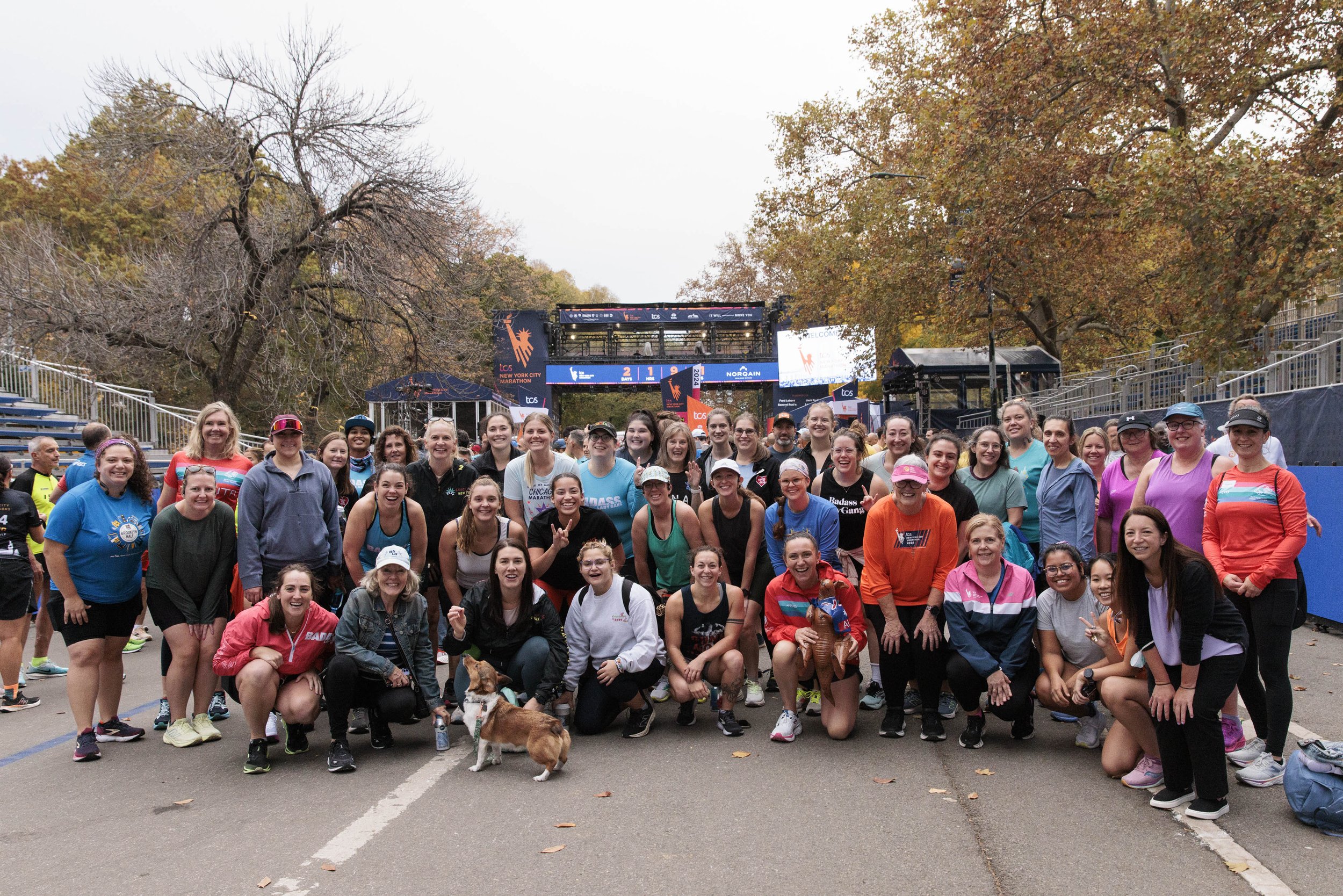
Want to run the NYC Marathon? It’s about this time of year when my inbox explodes with a variation of this email: "Coach Kelly, I want to run the marathon next year. When do I start?"
Here's the NYC Marathon training timeline but it all depends on where you're starting from. The NYC Marathon is the first Sunday in November, which would put the 2027 race on November 7. (Double-check the date with the New York Road Runners at nyrr.org, and remember, getting into the marathon is almost as hard as running it. Here is how to run the New York City Marathon.)
First, the Part Nobody Puts on the Training Calendar
A 16-week marathon cycle is the part that gets all the attention. But the cycle only works if you show up to it with a base. A base is a foundation of fitness where you spend time slowly building your weekly mileage so that a dedicated marathon block can afford for flexibility and fun.
So the smart timeline has three parts:
Build the base. Get comfortable running consistently before you add the big stuff.
Take some breaks. Two to four weeks of moving however you want, whenever you want, because you want to. Hike. Dance. Lift. Walk your dog slowly and complain about it. No plan, no pressure. Time away from a structured plan helps you avoid burning out.
Do the marathon cycle. 16-18 weeks ]of the actual marathon training cycle.
That break is not slacking. That's the part that keeps you from hitting week 9 of marathon training feeling like you've been running for a decade straight. Burnout is sneaky. A little flexibility between cycles is how you keep this fun.
If You're a New Runner: Start in Winter
Maybe you've never run a mile. Maybe you're a card-carrying member of the "I F*cking Hate Running Club." (I was the president. I have the emotional scars and the ankle-rolling-to-skip-PE history to prove it.) Running a marathon next November is absolutely on the table. It just starts with a much smaller goal.
Here's the path:
Step 1: Become a runner (8 weeks)
Start with Become a Runner: 8-Week 5K. It's free inside the BALG app, and it takes you from "I can't run" to finishing a 5K with run-walk intervals. If you've run before and you're coming back after time off, Get Back to Running: 8-Week 5K is the one for you. Also free.
Step 2: Pick a next cycle (8 or 12 weeks)
Once the 5K feels doable, you've got options:
An 8-week 10K cycle, or
A 12-week half marathon cycle
These cycles are not mandatory. But I'd really encourage at least one, because you'll build more fitness, get comfortable with longer efforts, and have a lot more fun on the marathon cycle that follows. The half marathon is also a great confidence builder, because you'll know you can cover more ground than you thought possible.
Step 3: Take 2 to 3 weeks to do whatever you want between phases
Seriously. Take the time. Move how you want to, when you want to, because you want to.
Step 4: The 16-week marathon cycle
Now you're ready for the real thing.
The new-runner math: 8 weeks (5K) + 8 to 12 weeks (10K or half) + 2 to 4 weeks (free time) + 16 weeks (marathon) = about 34 to 40 weeks. Counting back from early November 2027, that means starting somewhere between late January and mid-March 2027.
NOW, that doesn’t mean you start marathon training in January. Thinking about marathon training for 11 months is too much. So we keep the long term goal as our north star but focus on the short term goals in the immediate future.
If you're reading this in November 2026, that's good news. You have time. Plenty of it. Nobody's behind.
If You're Already Running: Build a Base First
Maybe you've got a 5K or a half marathon under your belt, and you're ready to go for the full 26.2. You're not starting from scratch, but you're also not ready to jump into marathon mileage next week. Just remember, 4-5 months is the max I recomend for any one marathon training cycle. Pick some short term goals that excite you while you work towards that November race day.
Step 1: Base building (at least 8 weeks)
A base is just consistent, mostly easy running that gets your body (and brain) ready to handle more. If you want somewhere to start, Back to Basics: 8-Week Base Building is free in the BALG app.
Most of that running should feel easy. About 80% easy effort, 20% harder effort is the rule of thumb I coach by. Conversational pace is not a punishment. It's the point.
Step 2: Two weeks of whatever you want
Same deal as above. Take the break. Your body and your motivation will thank you.
Step 3: The marathon cycle (16 to 18 weeks)
Go for 16 weeks if your base is solid, or 18 if you'd like more breathing room in the build.
The experienced-runner math: 8 weeks (base) + 2 weeks (break) + 16 to 18 weeks (marathon) = about 26 to 28 weeks. Counting back from early November 2027, that's late April to early May 2027.
What Happens Inside a Marathon Cycle (the Version I'd Want You to Know)
A marathon cycle isn't just "run more." Here's what I coach:
We train by time, not distance
Two runners can cover the same mileage and have completely different experiences. One finishes in 3:45 and the other in 6:30, and those are very different amounts of time on your feet. Training by time means your plan fits your fitness, not someone else's pace. Your longest long run in a BALG marathon cycle tops out at 3 hours.
Most of your running is easy
Easy runs aren't "failed hard runs." They're how you build the fitness to run 26.2 without falling apart. If you run all your runs at medium-hard effort, you'll feel tired and not fast. Trust the easy.
Learn to Love Strength Work
The secret to feeling strong in the final hours of a marathon when everything hurts and you want to die is doing enough strength work to keep you smiling. My runners always think they need to run more when in reality, I often wish they had two strong 30-45 minute strength sessions in the mix. Lift heavy, enjoy explosive movements, and get strong. It will only help your marathon training.
Friends ALl Over The course
The best part of training with the Badass Lady Gang is our support system. The NYC Marathon is the Badass Lady Gang’s home race. So no matter where you live in the world, when you join our Fall Marathon training experience or Sunday meetups in NYC, you’ll get a support system to ride the Ferry with, hang in the start village, cheer for you all over the course, and support you at the end. Running isn’t a solo sport when you train with the gang. You get a network of Badass ladies who want to see you kick ass and take names!
Every workout is a coin in the coin jar
Done beats perfect. Ugly runs count. Rainy-Tuesday-and-I-don't-want-to runs count. The coins add up to a person who can stand at the start line and knows she did the work.
Pace like you want to feel good at mile 20
NYC has bridges, climbs, , a long stretch up First Avenue, and crowds that will tempt you to go out too fast. Be conservative early. Don't spend them in the first few miles. (Pain is information, by the way. If something hurts, rest, and see a qualified professional like a physical therapist who sees runners. Do not run through it because you think it’s normal. Discomfort is to be expected. But pain? Pain normally means something is wrong.)
How We Can Help You Get There
You can do almost all of the above with a free BALG account in our Badass Lady Gang training app. The community is free. The three Training Plans I mentioned are free. We also have free tools like the Fuel & Hydration Tracker, Goal Studio, and the Sports Bra Finder, because figuring out the basics shouldn't cost you anything.
When you want more structure or support, here's how it works:
The Studio ($9.99/month)
Strength workouts. Marathon training is hard on your body, and getting stronger is one of the best things you can do to stay healthy through the build.
The Team ($19.99/month)
A Running Plan built for you. You answer a few questions (your goal, race distance, current fitness, days per week) and get a plan that fits. The Team also gives you access to the Team Q&A feed, where you can post a question and a coach answers it. Running Plans come with The Team. They aren't sold on their own.
The Team with Coaching ($89.99/month or $599.99/year)
Everything in The Team, plus coach messaging and coaching calls. It also includes every Training Experience. This is where you get answers when something feels off, when your long run goes sideways, or when the voice in your head starts yelling halfway through a long run.
Private Coaching ($250/month)
Everything in The Team with Coaching, plus a weekly 1:1 call with me. Monthly only. If you want real, personalized, ongoing conversation about your training, your goals, and your big marathon dream, this is it. See Private Coaching.
The Fall Marathon Training Experience
Our 20-Week Fall Marathon Training Experience is a coached marathon program with a start date, a community of athletes training right alongside you, and coaching calls. It returns each season, and it isn't open for sign-up right now. It's included with The Team with Coaching, or you can watch balgtraining.com for the next one. A note: it runs 20 weeks, so if that's the route you want, count back from race day by 20 weeks instead of 16.
Why Train with Us?
Honestly? Because I'm not a gazelle either.
I'm a former running-hater who cried on street corners and thought everyone was judging me. I've since run marathons around the world, including New York, and I've coached first-timers, Boston qualifiers, and everyone in between. BALG is built for women who are strong but not perfect, who are busy, who are a little nervous, and who want someone to talk to them like a real human.
With us, you get:
A plan that fits your actual life. Time-based, effort-based, and built around you.
Community. Thousands of women training alongside you, with chapters across the US and Canada.
Coaching that's real. No toxic positivity, no diet culture, no shame. Just honest guidance, a good laugh, and a coin jar full of proof you showed up.
Support for the whole thing. Strength, fueling tools, mental game work, and coaches who've been where you are.
Frequently Asked Questions
How long does it take to train for the NYC Marathon?
For most people, the marathon cycle itself is 16 to 18 weeks. But if you're newer to running, plan for much longer overall. Add a base-building block, a break, and ideally a shorter race cycle before it. See the timelines above.
Can a beginner train for the NYC Marathon?
Yes. You'll just start with a smaller goal first. Our free Become a Runner: 8-Week 5K is a great place to begin. Give yourself roughly 34 to 40 weeks total, with a 5K and a 10K or half marathon along the way.
Do I need to run a half marathon before my first marathon?
No, you don't need to. But I'd recommend a shorter race cycle first (a 10K or half), because you'll be more prepared for the full 26.2 and you'll enjoy it more.
Why take a break between training cycles?
Because your body and your brain both need it. Two to four weeks of unstructured movement helps you recover, keeps you from burning out, and gets you excited to start again. It's part of the plan, not a detour from it.
What if I want a coach to help me?
You've got options: The Team for a Running Plan built for you, The Team with Coaching for coach messaging and coaching calls, or Private Coaching for a weekly 1:1 call with me. Learn more on balgtraining.com.
Your Next Step
Don't wait until July to figure this out. Start with whichever free option fits where you are right now:
New to running? Start Become a Runner: 8-Week 5K.
Coming back after time off? Start Get Back to Running: 8-Week 5K.
Already running and ready to build? Start Back to Basics: 8-Week Base Building.
All three live in the BALG app. Download it on iPhone or Android, or start on balgtraining.com.
The bridge, the First Avenue crowds, the Central Park finish: it's all coming. You've got time. Let's use it well.
— Coach Kelly
